Solar Power Enrichment
Advantages
Solutions
Disadvantages
How it works
Photovoltaic (PV) cells are made up of at least 2 semi-conductor layers. One layer containing a positive charge, the other a negative charge.
When light shines on the junction, an electron is freed as it gains enough energy to overcome the force acting on it. The freed electron will move from the N-layer to the P-layer, creating a voltage differential, similar to a household battery. The flow of electrons creates an electrical current which can be used to power appliances.
Each individual solar energy cell produces only 1-2 watts. To increase power output, cells are combined in a weather-tight package called a solar module. These modules (from one to several thousands) are then wired up in serial and/or parallel with one another, into what’s called a solar array, to create the desired voltage and amperage output required by the given project.

1. Solar Energy Makes The Grid More Secure
2. Environmentally Friendly
Solar energy has been popular amongst the US military elite for many years now thanks to the fact that solar panel systems are spread out — decentralized — and thus can make the overall electricity network much more secure (especially when used in microgrids). It’s much easier for an enemy to disrupt your electricity grid if they can target one or two large power plants and take them down. When you have thousands or even millions of power plants spread out on roofs and land all over the place, that becomes much more difficult.
Of course, grid security isn’t just about protection from potential enemies. Natural disasters such as storms and floods can also wreak havoc on a grid and result in blackouts and brownouts — as those hit by Superstorm Sandy are well aware. This is the much greater threat that focuses our electricity grid today. A decentralized, solar-supported grid can help prevent such problems. It’s a direction in which we should be moving.
Solar energy makes use of sunlight and does not require fossil fuels to be burnt unlike fossil fuel. It does not release gases like methane or carbon monoxide. Only during its production of some materials, carbon dioxide is released. However in the long run, it is environmentally friendly.
Because solar doesn’t rely on constantly mining raw materials, it doesn’t result in the destruction of forests and eco-systems that occurs with many fossil fuel operations.
Destruction can come in many forms, from destruction through accepted extraction methods, to more irresponsible practices in vulnerable areas, to accidents.
The Niger Delta is an example where excessive and irresponsible oil extraction practices have poisoned fishing deltas previously used by villagers as the main source of food and employment, creating extremely desperate poverty and essentially decimating villages.
A 1-kilowatt home system will help prevent 170 lbs of coal being burned into the air, 300 lbs of CO2 from being released and 105 gallons of water from being consumed each month! Even in Hwa Chong, with 84 solar panels, an estimated 8 tons of carbon emission is reduced.
The P-layer consists of silicon atoms and an element with a valence electron of 3, such as boron. When boron is doped, it bonds with the silicon atoms however, there will be one missing electron, making the layer positively charged.
The N-layer consists of silicon atoms and an element with a valence electron of 5, such as phosphorus. When phosphorous is doped, it bonds with the silicon atoms however, there will be one delocalised electron, making the layer negatively charges.
3. Sustainability
Solar energy is a renewable source of energy as it utilises sunlight which is a natural resource. The sun will only die a few billion years later, making it a sustainable source of energy. Also, solar panels only require replacement every 20-40 years, making it sustainable.
4. Avoids Politics and Price Volatility
One of the biggest advantages of solar energy is the ability to avoid the politics and price volatility that is increasingly characterising fossil fuel markets.
The sun is an unlimited commodity that can be sourced from many locations, meaning solar is less vulnerable to the price manipulations and politics that had doubled the price of many fossil fuels in the past decades.
While the price of fossil fuels have increased, the per watt price of solar energy production has more than halved in the past decade – and is set to become even cheaper in the near future as better technology and economies of scale take effect.
Furthermore, the ever-abundant nature of the sun’s energy would hint at a democratic and competitive energy market – where wars aren’t fought over oil fields and high-demand raw materials aren’t controlled by monopolies.
Of course, a new form of politics has emerged with regard to government incentives and the adoption of solar, however these politics are arguably minor compared to the fossil fuel status quo.
2. Inefficient
1. Inconsistent
The efficiency of solar energy is still low, where the maximum efficiency in labs is only 44.7%. This is further brought down as ideal conditions do not exist in the real world, and we are affected by the climate and this brings it down. This means that a fairly vast amount of surface area is required to produce adequate electricity.
Solar panels generally require very little maintenance since there are no moving parts. A few times a year, the panels should be inspected for any dirt or debris that may collect on them. Parts do not rust or breakdown, thus little maintenance is required. As oppose to fossil fuel, coal handling is involved. This includes coal receiving (either by rail or water), storage and recovery for fuelling the turbine generator units. Furthermore there are dangers such as heat stress.
Solar energy doesn’t work at night. The biggest disadvantage of solar energy is that it’s not constant. To produce solar electricity there must be sunlight. So energy must be stored or sourced elsewhere at night. Beyond daily fluctuations, solar production decreases over winter months when there are less sunlight hours and sun radiation is less intense. Furthmore, if it is very cloudy, it will affect the solar panels. A 1-kilowatt solar system can generate about 1,600 kilowatts-hour per year in a sunny climate and about 750 kilowatts-hours per year in a cloudy climate.
5. Require little or no maintenance
4. Storage Battery
3. Fund Research
2. Education
1. Advertising
This can help raise awareness regarding the benefits of solar energy which may in turn encourage people to use it. As long as there is a demand for solar panels in the market, producers will be pushed to develop better products. Also, by creating these campaigns, we raise the matter of global warming and the negative impacts of burning fossil fuel to the public. This may lead them to have a change in lifestyle and use solar energy.
5. Tax Reduction
The hard truth is that the price of solar power is higher than the price of fossil fuel energy. The National Renewable Energy Laboratory estimates that the average residential solar panel system can cost between $16,000 and $22,000.
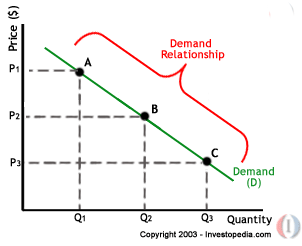
Therefore, the tax reduction would lessen the cost of the photovoltaic systems, which makes the break-even occur earlier. This will encourage more people and companies to purchase and install PV systems. This would increase the demand for photovoltaic panels and other equipment thus creating more jobs and having positive impact on the economy. According to the Law of Demand, if all other factors remain equal, the higher the price of a good, the less people will demand that good. Thus we a lower price, more people will buy, encouraging people to buy it.
Singapore is investing in research and development, and test bedding to build our capabilities in clean energy. Some of our test-bedding projects include:
-
Housing and Development Board's (HDB) initiative to install solar panels on rooftops of high-rise public housing developments, and
-
the Economic Development Board's (EDB) and PUB's floating photovoltaic (PV) project, which will pilot solar panel installations on water surfaces at our reservoirs.
By funding research, we can create more efficient solar panels thus allowing more energy to be generated. With more government funding, our scientists and engineers will be able to make new breakthroughs in the forefronts of Photovoltaic technology and develop solar panels with better efficiency and pricing. Therefore, an increase in research and development budgeting and grants would provide opportunities for local and foreign partnership, which will lead to the development of better photovoltaic systems.
Solar panels cannot work at night thus people rely on storage batteries, that are charged in the morning, to store the energy to be used at night. Like in Hwa Chong, the electricity generated in the day would be stored to power the spotlights that illuminated the clock tower at night.
However there is a limit to how much electricity can be stored. The normal storage is the Lead-Acid battery. Furthermore, Lead Acid Batteries can contain a large amount of electrical energy which they are capable of discharging very quickly if any form of conductor is placed accros their terminals. However, Lead acid batteris contain Sulpuric Acid which is corrosive. They also give off hydrogen when they are being charged, which when mixed with air is explosive, and can be ignited by a small spark.
Research is needed to improve storage technology and make it safer. Fundings from the government will allow researchers to develop better technologies to combat these problems.
By educating companies and students about the benefits of solar energy and the disadvantages of burning fossil fuels, they may start using solar panels. Through raising awareness and changing the mindset of people, over time more people will choose solar panels as oppose to other energy sources.
6. Raising Renewable Portfolio Standards
Renewable portfolio standards is a regulation that requires the increased production of renewable energy sources. By raising the standards, companies would have to make use of alternative energy sources like solar energy to generate electricity. Some provinces and territories have introduced renewable portfolio standards in their electricity markets that include solar. For example, the Government of the Northwest Territories has developed an energy strategy that sets targets for renewable energy, including solar energy. The territory plans to obtain 10 per cent of its energy from renewable energy sources, such as solar, wind, biomass and hydro, by 2010, and 25 per cent by 2025. By raising the standards, they would have to use alternative energy sources more often, over time they may adopt it permanently.